

Craig DiLouie
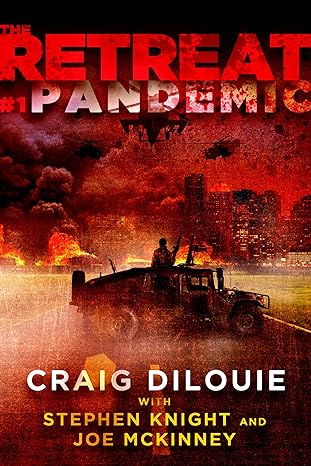
I have wanted to write this review for a very long time, but never actually got around to it for various reasons. And as it’s been several years since I had a chance to read and review any books and I’m determined to make up for lost time, let me get straight to the point of this review. The Retreat as a series is some of best apocalyptic horror fiction I have ever read in my many years of reading and then reviewing horror fiction; and The Retreat #1: The Pandemic is the best book in the series. I have lost count of the number of times that I have read this book since I discovered it some years ago; if it were a paperback book rather than an eBook, then its spine would long ago have given way, and the pages would be falling out and stuck back in with tape. I have read it innumerable times in the past, and will very likely continue to read it well into the future. To quote an ancient meme: this is what peak apocalyptic horror fiction performance looks like.
Now let’s be clear: I’m a book reviewer who always tries to be positive in my reviews and highlight the best parts of titles I review on this blog; but even for me, the above is extremely high praise. So you – the hypothetical reader of this blog – must surely be asking yourself a simple question? What makes The Retreat #1: Pandemic worthy of such effusive and unconditional approval? Well to begin with, I would point towards its author – Craig DiLouie. I’ve reviewed several of his books here on the blog before – including his superb World War II thriller Armor which follows a tank crew through the North African campaign; and his zombie-centric The Front: Berlin or Bust. But these barely scratch the surface of DiLouie’s talents as a writer, particularly in the horror genre, and while I haven’t reviewed them (yet) I cannot recommend enough his later novels like Suffer the Children and The Children of Red Peak, or his latest release How to Make a Horror Movie which I cannot wait to get to reviewing. DiLouie is an incredible author, imbuing whatever he writes with colourful, engaging characters that draw you into his complex, multi-layered stories that linger with you long after finishing the novels they’re found in.
So we have an excellent author – one necessary building block – but that’s far from enough. I’ve read an endless array of excellent authors who have written passable or genuinely terrible novels as part of their career, so that by itself isn’t a guarantee of success. To explain the other factors that has turned this into a must-read novel for me, and one that’s constantly on my (virtual) bookshelf, we need to dive into what the book’s actually about. As the novel – and The Retreat as a series – begins, the United States is on the verge of collapsing from a viral pandemic that has turned those it infects into insane psychopaths who have lost all reason, and whose only desire is to kill, maim and infect those left untouched by the virus. While the city of Boston burns, its population either dead, infected or fleeing in terror, one of the last remaining U.S. Army units trying to defend the city – a battalion belonging to the 10th Mountain Division – find themselves worn down by weeks of fighting and at the brink of destruction. Desertions sore, ammunition stockpiles are critically low, and the battalion is split into smaller and smaller elements trying to defend a city that has already fallen. With regimental commanders either infected or dead, senior officer Captain Harry Lee is faced with a quixotic choice: fight to the death in Boston, or lead the remnants of his battalion in a desperate rearguard action through millions of infected towards Florida, the last bastion of uninfected humanity in the country.
Now in your standard apocalyptic horror novel, the above scenario would merely be the prologue used to set the scene and demonstrate just how doomed the United States – and the world as a whole – is at the beginning of the novel. In less talented hands, the heroic Captain Lee would see the men and women under his command slaughtered to the last, and he would be the last person alive. Left alone and ready to undertake the usual Hero’s Journey trope across the country to achieve some objective typical of the genre – rescue a loved one or kill the Big Bad Guy(s) at the heart of the conspiracy. The soldiers of the 10th Mountain Division would merely act as glorified Redshirts, used for a few intense and poorly-researched action sequences that would end by the fourth chapter or so; I’ve seen it happen a hundred times before in the genre.
What makes The Retreat stand out – particularly Pandemic as the first novel in the series – is that DiLouie refuses to follow these usual tropes, and instead takes the much harder decision to have the battalion remain intact and fight its way towards safety. In doing so, DiLouie ensures that the soldiers of the 10th Mountain Division are actually treated as individual characters with their own stories, motivations and goals – rather than as extras to be killed in the opening minutes of the apocalypse. Doing so also makes for a far more complex and intriguing story – as rather than focusing on a single character as is usual with apocalyptic stories, DiLouie gives us the viewpoints of a handful of soldiers fighting to stay alive and uninfected and stay together as a cohesive fighting force. The battalion effectively becomes a character itself, and DiLouie deftly pivots between different elements of the formation as we see its surviving members work together to survive – as well as the view of the grunts on the front line, we see the fighting from the point of view of intelligence officers attempting to coordinate the retreat while trying to filter useful information from utter chaos, and even the pilots and crew of helicopters attached to the battalion during the fighting.
The characterization is nuanced and engaging at all times, and I was pleasantly surprised to find that DiLouie was able to give depth and meaning to soldiers who might only appear for a few pages before being killed off in one manner or another. We rotate through a small number of protagonists as the story unfolds, and while not all of them survive, I never felt cheated of a story or that DiLouie was showing me something pointless or written just to get another chapter under his belt; it’s a slimmed-down, fast-paced and efficient plot that emphasizes the horror of the situation in Boston without any padding, which again is something that’s rare in the genre.
And while the human characters are engaging, I need to give special praise to the infected hordes that the battalion fight their way through. Dubbed the ‘Klowns’ by the soldiers, they’re one of the most unsettling and genuinely terrifying creations I’ve ever come across in all of the apocalyptic fiction that I’ve read over the years. Usually when an author presents us with an infected horde-style situation such as this, the rule of thumb is that they’re either numerous or intelligent – you’ve either got millions of shuffling zombies that can’t do anything else than go towards the nearest sound, or a small number of enemies that can plot and plan and use weapons. But in The Retreat DiLouie has combined both aspects in the Klowns – the infection takes over the host’s body in mere seconds, and allows them the ability to retain whatever skills they had before infection. So not only do they outnumber the 10th Mountain Division soldiers, they can also use their intelligence and weapons to fight them. Which leads to some incredible scenes later in the novel, as infected National Guardsmen begin fighting the battalion with the same weapons that they’re trying to use to escape.
Honestly, there’s so much more that I could write about this novel – this could easily go from a book review to an entire essay; and I’m definitely going to be returning to the other novels in the series, written both by DiLouie and equally talented authors such as Stephen Knight and Joe McKinney. I could talk about the way in which DiLouie manages to balance the inclusion of accurately-named and utilized military equipment without drowning the reader in mystifying acronyms and dense screeds of explanatory text; or the nauseating, intensely biological ways in which the Klowns infect their victims in ways that would make even hardened Warhammer 40,000 readers recoil from the page; and the psychological horror elements that DiLouie introduces, where soldiers cannot express any happiness or even laughter for fear of being mistaken for one of the infected.
But I’ll leave those elements for future reviews of The Retreat series as a whole, and instead close by noting that The Retreat #1: Pandemic is by far the best piece of apocalyptic horror fiction that I have read in a number of years, and a superb military horror novel that deserves to be discussed in the same breath as Weston Ochse’s Burning Sky. I cannot urge you strongly enough – pick up a copy of The Retreat and you will not be sorry; and like me, I can guarantee you’ll be hooked from the first chapters and soon find yourself reading the rest of the series.

 The Sci-Fi and Fantasy Reviewer